
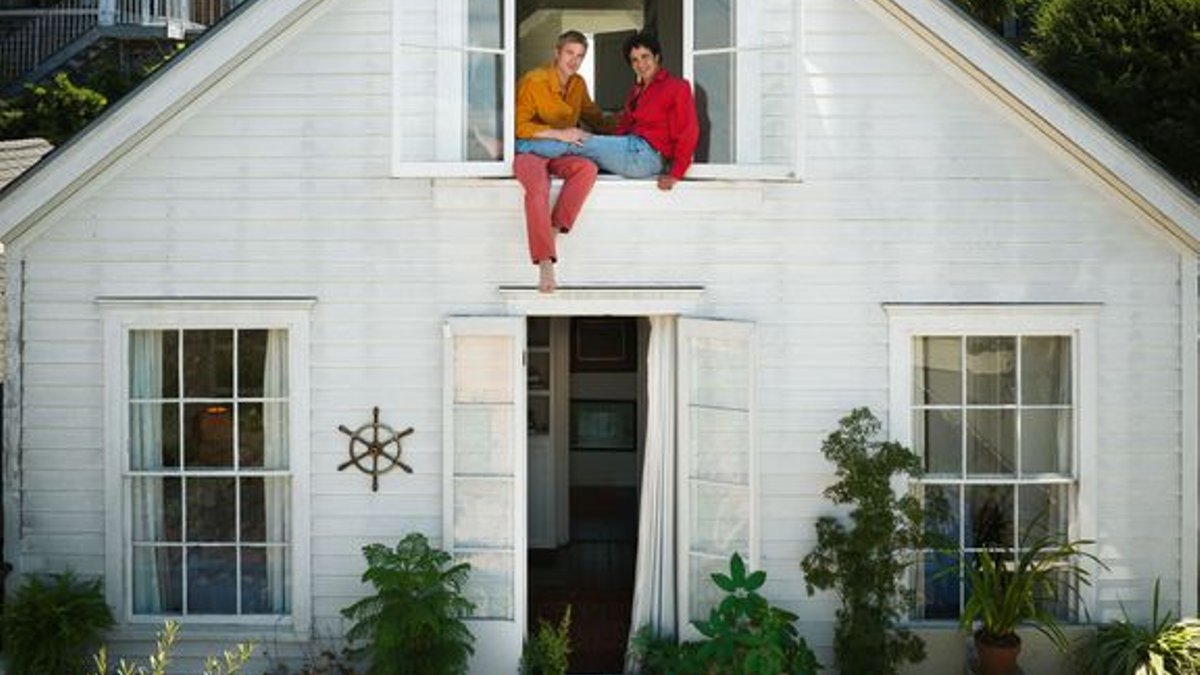
Zac Posen and Harrison Ball never planned to restore a historic San Francisco home. Their goal was simply to create a space that mirrored their personalities.
The pair—a fashion designer and a former New York City Ballet principal—discovered their Telegraph Hill rental two years earlier. The property was an 1850s captain’s cottage, its charm overshadowed by neglect. Overgrown gardens, sparse furnishings, and walls bearing decades of stains defined its state. “It was furnished but it had an Airbnb vibe,” Ball recalls. “The garden was dead. Moss everywhere.”
Ball, who describes himself as a “Zillow queen,” had nearly leased another home when he encountered this listing. The moment he saw it, he was certain. “I knew before I saw it that this was it: by the sea, a metropolitan New York feeling but on island time. I grew up going to Robin Hood’s Bay in Yorkshire, so this was like finding my old family house again,” he says. Posen, then newly appointed as Gap Inc.’s creative director, shared his enthusiasm. The couple moved in alongside two miniature poodles, a Pennsylvania painting, and a trunk of possessions.
The cottage carried layers of history. A Russian noble had once resided there before it became a Prohibition-era club. Joan Baez reportedly stayed briefly, and Armistead Maupin lived nearby while writing Tales of the City. Yet the structure itself seemed forgotten, walls stripped bare, floors uneven, its character buried under years of disregard.
Adopting Imperfection Through Minimalist Design
That changed when they met Ken Fulk, the interior designer, weeks after moving in. Fulk had previously advised Posen on projects and immediately offered his assistance. Unlike conventional designer interventions, his method was minimal. “No mood board, no concept presentation,” he says. “The cottage is delightfully imperfect.”
Related Post: Smart Design and Apps Streamline Everyday Home Life
The finished result avoids refinement. The guest room, with its whitewashed beams and sloping ceilings, evokes an untouched Montauk beach house. The primary bedroom, overlooking the bay, combines a Persian rug, Posen’s father’s artwork, and a 1930s faux-bamboo bed, arranged with deliberate, lived-in disorder. The kitchen retains its original 1950s O’Keefe & Merritt stove and worn white cabinets, repainted by Ball.
The decor reflects their backgrounds, Banana Republic fabric remnants draped on walls, a discontinued scarlet velvet sofa, and vintage desks hinting at the cottage’s first owner, a seafaring captain. Even Ball’s imperfect paint choices became part of its appeal.
Fulk’s hands-off approach extended beyond decor. The couple handled much of the labor themselves. Ball repainted the kitchen’s cornice after disliking the yellow scalloped border that Ken’s team had applied. The 1950s stove remains untouched. The garden, now flourishing with pink begonias and Brugmansia, was planted by Ball using local nursery cuttings.
Balancing Love, Art, and Bicoastal Life
Their bicoastal lifestyle complicates long-term plans. Though engaged for four years, the couple splits time between San Francisco and New York, where Posen leads Gap Inc. and Old Navy as executive vice president and creative director. Ball, now retired from New York City Ballet but active in acting, including a role in Brokeback Mountain at Chicago Shakespeare Theater, balances auditions, rehearsals, and the cottage. “We’ll probably be engaged for another 20.” The rental status prevents permanent changes, yet temporary fixes have already been outgrown. The walls now display Posen’s father’s artwork and Banana Republic fabric samples.
Research into the cottage’s past revealed a Russian aristocrat’s prior residence before Prohibition transformed it into a speakeasy. Martha Stewart has also dined inside, though neither the couple nor Fulk could verify details.


