
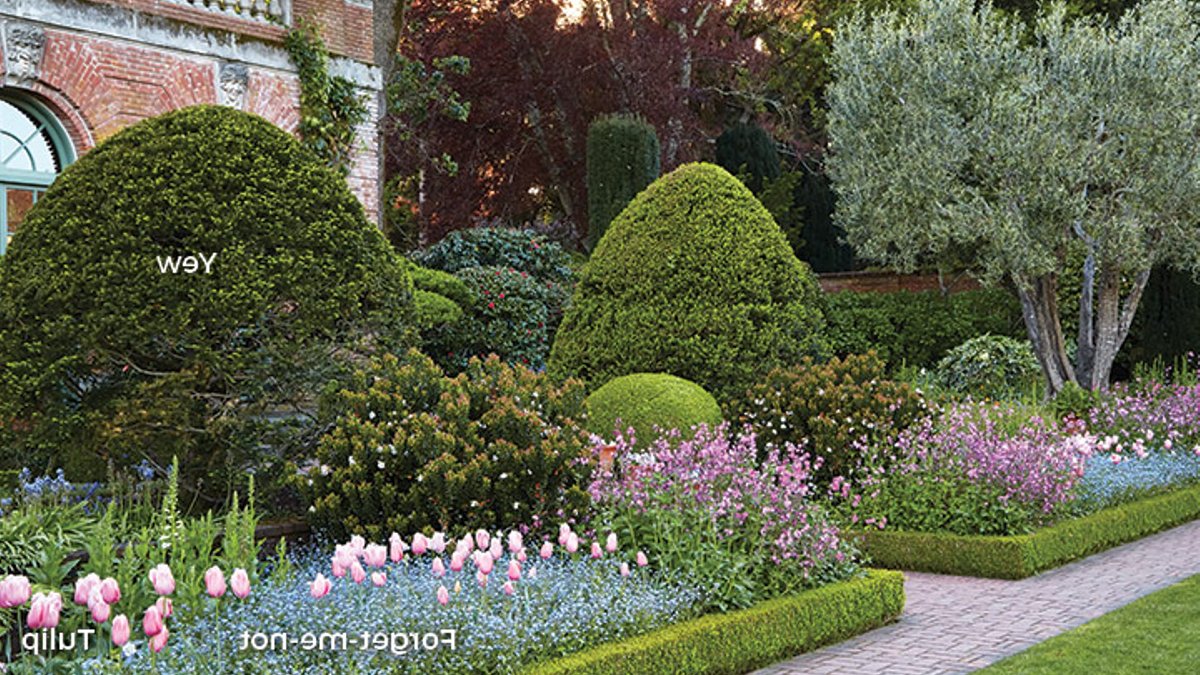
Adding structure to your garden helps create a backdrop and offers a sense of permanence no matter the season. Colorful blooms come and go, but an evergreen backdrop provides constant interest. Evergreens grow in a range of habits from pyramidal to globe-shaped. Plus, there are many that are simple to cut into the shape you want, such as boxwoods (Buxus spp. and hybrids) and yews (Taxus spp. and hybrids).
Use Hedges and Borders
Planted close enough together, boxwoods grow to form a hedge. Keeping it tightly clipped draws the eye quickly along the walkway beside it, leading right to the door. This low border also serves as a frame for what grows beyond it. The squared shape and dense, rounded mounds create repetition and symmetry in a garden that mixes several types of plants.
Incorporating hardscaping elements can further define the space. The well-spaced boulders in a garden add unique contrast with their texture, form and even color. While their shape echoes other low-growing mounds in the yard, the boulders’ smooth surface and neutral hue provide resting places for the eye as it scans the garden.
Related: Six Smart Tips for a Thriving Summer Garden
Winter can be a long, difficult season. Perennials have gone dormant, and much of the color in the yard has vanished. Though deciduous shrubs and trees have dropped their leaves, fully exposing the garden’s bones, there doesn’t have to be a lack of interest. In the photo above, weeping and upright branches still add shape, even without their leaves. And redtwig dogwood (Cornus alba) draws attention with bright, colorful bark, working like an exclamation point in the setting.
Create Focal Points with Contrast
Build even more interest with the bones of your garden when you focus on shape and color. Alone, the tight pyramid of the juniper (Juniperus chinensis) is eye-catching. Surrounded by softer, airy, vase-shaped ornamental grass, like maiden grass (Miscanthus sinensis), however, the dense evergreen becomes an especially striking focal point. A sweep of bright red Japanese blood grass (Imperata cylindrica) provides balance to the variety of cool green hues. The cream-variegated leaves of weigela (Weigela florida) help brighten the border, too.
The ornaments and objects throughout your garden are just as important as the plants that grow there. Depending on their material and the winter weather in your region, many can stay in place throughout the year, meaning interest no matter the season. The garden in the photo above relies on containers and ornaments set into the border and along a wall to draw the eye deeper and up. In this formal-feeling garden, a mix of materials, from the metal planters to the cast-concrete ornament to the stone figure in the fountain, still has a cohesive feel. That’s because there’s not an abundance of variation. With its bold presence, the wall of stacked stone is a handsome hardscaping addition, breaking up some of the fine textures throughout the border.
Related: 3 Water-Wise Gardening Hacks for Your Home
Use accents to create extra interest. Choose just about any sort of unique object to use as an ornament in the garden, but consider the spot you’d like it to go, too. This way, you can accentuate certain combos or play up the already-interesting traits of a planting. With their geometric shapes and lines, the metal orbs in the photo, for example, are a nice contrast to the stand of wispy tufts of blue fescue (Festuca glauca). They add shape and structure that helps define this area.
Redosier dogwood has white spring flowers and green foliage that turns red and orange before changing to purple in fall. But it’s this shrub’s red winter branches that stand out most, especially after snow. Give redosier dogwood a place in full sun to part shade. Plants grow 3 to 10 ft. tall and 5 to 10 ft. wide in USDA zones 2 to 8.
Boxwood’s good-looking evergreen foliage fills out to form a dense mound. Let it grow in its natural habit or prune plants back in spring to maintain the shape you prefer. Depending on the cultivar, this shrub grows 1 to 15 ft. tall and 1 to 15 ft. wide in full sun to part shade. Boxwood is cold hardy in USDA zones 4.
Related: Expert design and time grow lush gardens
Add color and vertical interest to fences, pergolas, arbors or trellises in full sun or part shade with clematis, which reaches 1 to 30 ft. tall and 3 to 8 ft. wide. Flowers open in shades of pink, red, white, purple, yellow, blue and even bicolor in late spring, early summer, midsummer and fall. This perennial is cold hardy in USDA zones 3 to 9. ‘Jackmanii Superba’ in the photo is an improvement over classic ‘Jackmanii’, with more profuse purple blooms from early summer to fall. It grows 10 to 12 ft. tall and 2 to 4 ft. wide.
Yucca’s green, bladelike evergreen foliage is deer- and rabbit-resistant. Some cultivars, such as ‘Color Guard’, which grows 18 to 24 in. tall and 24 to 36 in. wide, have bright yellow variegation. Butterflies love the cream-colored summer flowers. This perennial grows 18 to 36 in. tall and 18 to 48 in. wide, with flower spikes that reach up to 6 ft. Yucca likes full sun best. It’s cold hardy in USDA zones 4 to 11.
Draw the eye up! It’s easy with Rocky Mountain juniper. Since it ranges in size from 10 to 24 ft. tall and 2 to 12 ft. wide, this columnar evergreen tree makes an especially good screen in a narrow space. Flat green foliage can be tinted gray or blue, like ‘Wichita Blue’ in the photo, which holds its color well and reaches 10 to 12 ft. tall and 3 to 4 ft. wide. Rocky Mountain juniper grows best in full sun and USDA zones 3 to 9.


