
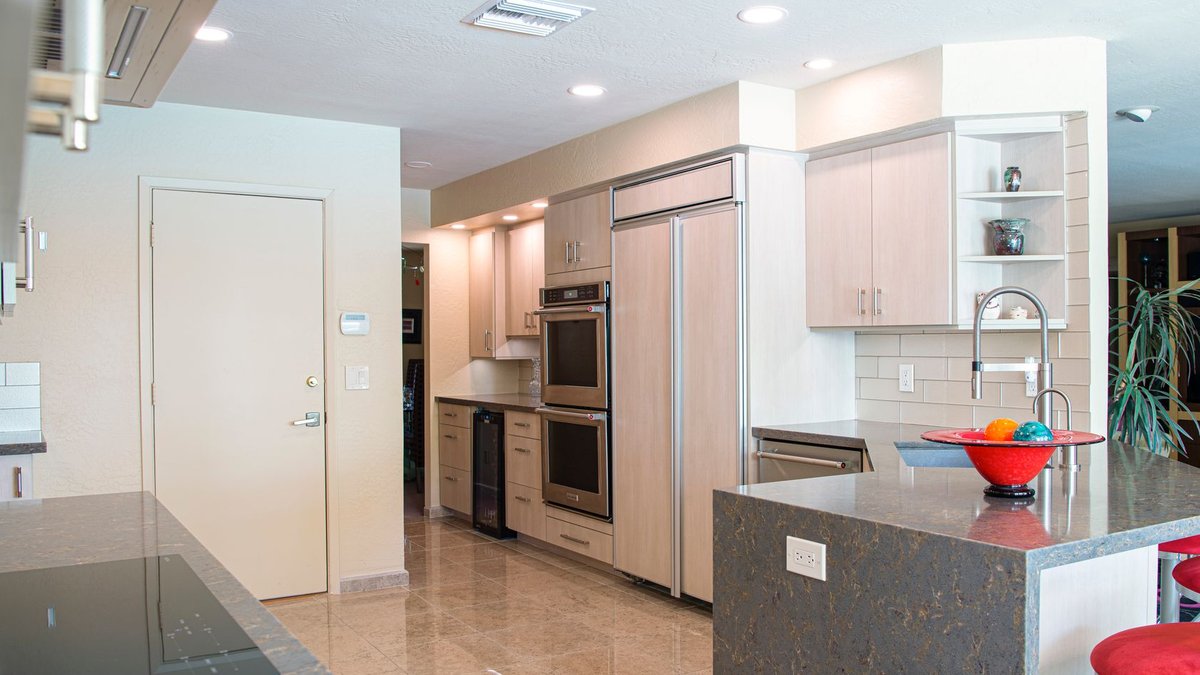
Kitchen design trends are turning away from fully open plans, according to the National Kitchen and Bath Association’s 2027 Kitchen Trends Report. The shift favors a blend of open and enclosed zones, reshaping layouts, adjacent rooms, and storage options.
Shift Toward Mixed Layouts
Fully exposed floor plans are losing appeal as homeowners seek practicality. Designers now recommend a balanced approach that mixes visibility with defined sections, allowing both social interaction and focused work.
Partial walls and operable partitions are gaining traction, and more than 80% of professionals say “intentional zoning” will remain a staple. The move supports flexibility without sacrificing the sense of space.
Survey results show 46% favor semi-enclosed configurations, while 41% back partially concealed designs. At the same time, 64% consider open shelving outdated, and nearly half anticipate a resurgence of a dedicated back cooking area.
Bill Darcy, global president & CEO of the NKBA, says, “While the kitchen has always been the ‘heart of the home,’ that idea has taken on new meaning. From mudrooms and laundry rooms to back pantries and personalized work zones, the report shows that we’ve entered a new era of what the kitchen can do for homeowners—solving real problems, adding home value, and raising the way we live.”
Homeowners are becoming more pragmatic, especially as dwelling sizes shrink. The ability to toggle between open and closed zones offers multifunctional possibilities that suit smaller footprints.
Empty visual corridors are being replaced with added storage, extra seating, auxiliary prep stations, and adaptable corners. These elements prioritize function over sheer volume.
Expanding Functional Zones
Designers see the kitchen as the hub of a functional ecosystem that supports daily living, including the laundry and mudrooms. In fact, 94% predict that mudrooms attached to the kitchen will grow in popularity, with many expecting larger laundry spaces as well.
Although overall room size is still projected to increase, the forecast has softened: only 52% now anticipate larger layouts, down from 76% a year earlier.
When expansion occurs, the added square footage typically goes to practical, adjacent spaces, such as butler pantries, back kitchens, and concealed storage. Pantries are evolving beyond storage into multifunctional extensions of the kitchen, with dedicated small-appliance stations and walk-in layouts becoming key design features.
Neutral tones dominate the color palette, reflecting a preference for practical design choices. Warmer hues, like reds and yellows, are gaining traction.
Natural wood cabinetry is popular, with homeowners leaning toward medium and light tones almost equally. Meanwhile, over half of designers predict that kitchen islands will be in a different color than the perimeter cabinetry.
Quartzite has gained significant traction for kitchen countertops since last year, moving past long-time favorite quartz for the most popular choice.
Wellness and climate resilience have influence as homeowners begin to more deeply understand the relationship between home design and wellness. Ventilation, water filtration, touchless faucets, and sound-absorbing materials are all gaining in popularity.
Designers say to watch for increased interest in leak detection systems, shut-off valves, and backup power. Smart tech continues to be in demand in the kitchen, but homeowners are more hesitant with AI. Designers say only 27% of homeowners are choosing AI-integrated ovens.
Kitchen islands are the most sought-after custom feature. Look for zoned island layouts, integrated tech features, and more storage. Lighting is becoming central to kitchen design, for a more dynamic aesthetic, according to designers. Task lighting, like undercabinet lights, recessed lighting, and in-cabinet lighting, will be popular, while pendant lights and chandeliers continue to be in demand.
Lifestyle features that boost functionality are expected to be on the rise over the next few years, especially beverage stations, pet feeding stations, and eat-in kitchens.


