
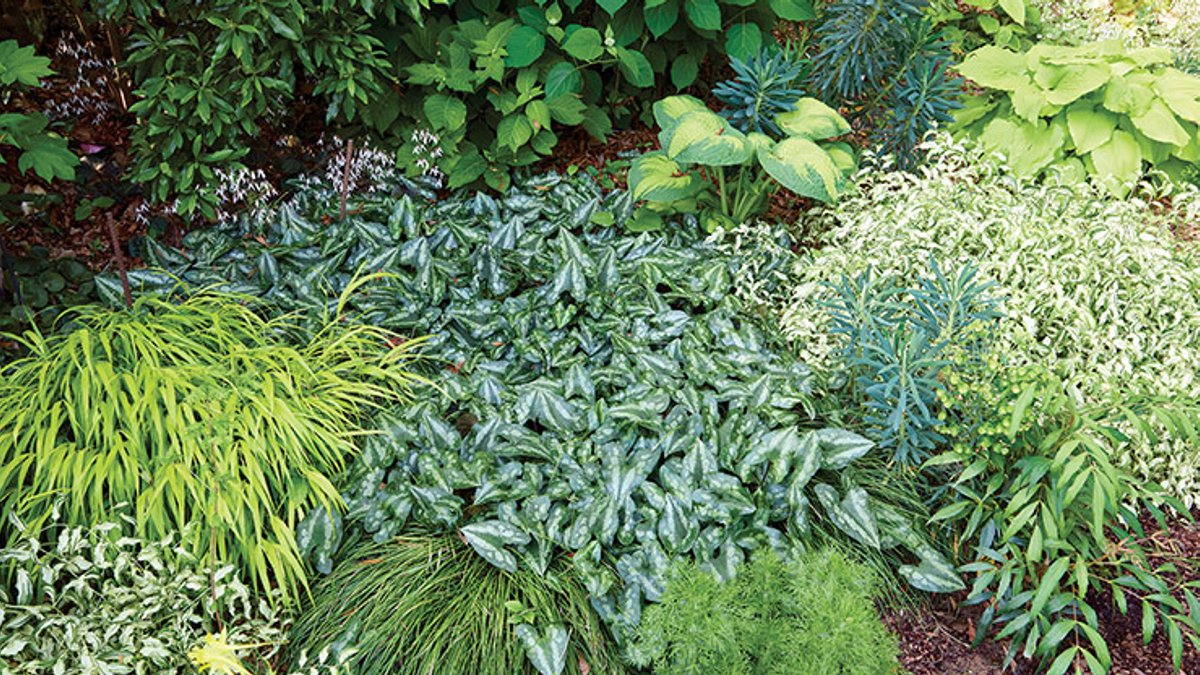
A shade garden can thrive without a single bloom. The key is foliage—layers of texture, color, and movement that form a living mosaic even in the dimmest corners of a yard.
One design avoids flowers almost entirely, using variegated leaves, grassy blades, and heart-shaped ground covers instead. The bed shifts with the seasons, offering visual interest without relying on petals.
How the plants work together
The plan centers on Chinese fairy bells, a perennial with white-streaked leaves that turn pink in cooler weather. Its arching stems frame the bed, while chartreuse hakonechloa and Taiwan mondo grass weave through the lower layers. Their fine blades contrast with the broad, puckered leaves of hostas and the feathery fronds of dog fennel.
At ground level, Chinese wild ginger spreads via rhizomes. Its silver-splashed foliage forms a dense mat that blocks weeds. The plants balance each other’s growth—clumping species like hakonechloa and mondo grass expand slowly, while fairy bells and ginger fill gaps without overwhelming neighbors.
Upkeep is simple. In early spring, damaged foliage can be trimmed or sheared to the ground, but the design looks best when left natural. The bed thrives in part to full shade and prefers evenly moist soil, though most plants tolerate brief dry spells once established.
The plants in detail
Chinese fairy bells (Disporum cantoniense ‘Moonlight’) reach 18 to 24 inches tall and wide, with small white flower clusters in late spring. The variegated leaves hold their color from spring through fall in USDA zones 7 to 9.
Hosta ‘Brother Stefan’ adds structure with golden-centered leaves growing 20 to 22 inches tall and up to 36 inches wide. It produces white spikes in early summer but is grown mainly for its bold foliage, hardy in zones 3 to 8.
Chinese wild ginger (Asarum splendens) stays low at 6 to 9 inches tall. Its heart-shaped, silver-mottled leaves create a striking ground cover. Tiny purple flowers appear in early spring but go unnoticed. It survives winters in zones 5 to 9.
Related: Designer reveals sources of creative spark
Hakonechloa ‘All Gold’ brings movement, its bright chartreuse blades swaying in the breeze. The grass grows 12 to 18 inches tall and wide, with tan flowers in midsummer that blend into the foliage. It performs reliably in zones 5 to 9.
Dog fennel (Eupatorium capillifolium ‘Elegant Feather’) is the tallest element at 3 to 6 feet. Its feathery green foliage turns red in fall, though its small white flowers are sterile. It prefers full sun but adapts to part shade, thriving in zones 6 to 9.
Taiwan mondo grass (Ophiopogon formosanus) forms a low carpet at 4 to 6 inches tall but spreads 24 to 36 inches wide. White summer flowers yield blue berries, though the light green foliage is the main attraction. It grows well in zones 7 to 9.
This method of shade gardening requires patience. The plants take a year or two to fill in, but once settled, they form a durable arrangement that evolves with the seasons. The absence of flowers isn’t a drawback—it’s intentional. Where light is scarce, foliage takes center stage, and color comes from leaves rather than petals.
Most of these plants are available at nurseries, though some, like Taiwan mondo grass, may need a specialty supplier. The design works best in a bed at least 6 feet wide, allowing layers to spread without crowding. For smaller spaces, taller elements like dog fennel and hostas can be reduced or removed.
The garden may lack floral drama, but it gains resilience. These plants endure shade, moisture changes, and occasional neglect. They don’t demand attention, yet they create a space that feels alive year-round, even when nothing blooms.
A single sentence can capture the appeal: Foliage outlasts flowers.


