
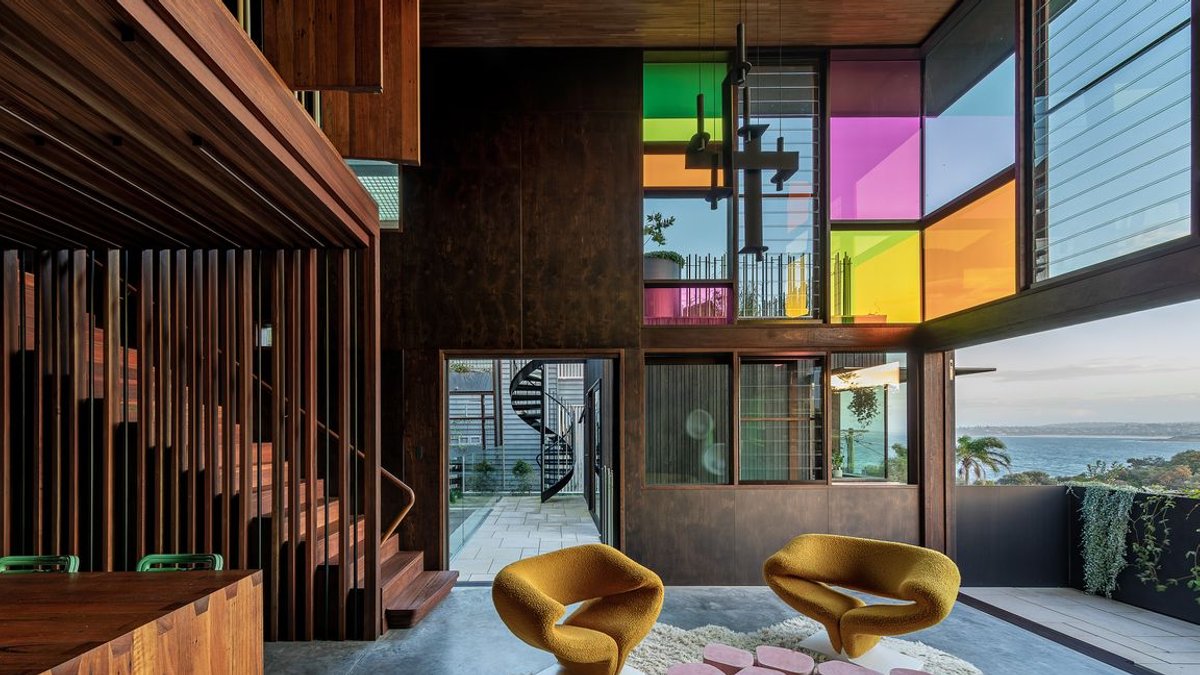
Stained glass is no longer limited to cathedrals and churches. Over time, it has become a desirable element in modern residences, merging age-old techniques with contemporary aesthetics. Artists and designers describe this trend as part of a larger cultural movement—one that celebrates handcrafted artistry in an age overwhelmingly shaped by digital production.
Pasadena-based artist Scotlan Goldbeck first discovered stained glass as a child, captivated by how colored panes transformed light into ever-changing patterns. When she renovated her 1906 Craftsman home, she commissioned a custom window from artist Debbie Bean. The result was a living room centerpiece featuring abstract shapes in blues, greens, and oranges. “There’s something spiritual about the different ways light shines through it,” Goldbeck says of the stained-glass window Debbie Bean crafted for the space. “It feels simultaneously ancient and present.”
Her experience reflects a rising demand among homeowners and designers. California-based designer Sarah Giesenhagen, creative director of the Bureau, notes that no client has rejected stained glass in recent projects. “It is an awe-inducing, experiential win,” she states. Her firm has integrated patterned glass into nearly every project over the past few years. Meanwhile, Rafael Calvo, owner of San Gabriel-based glass art company Tico Tech, currently has 18 custom windows on order—primarily for residential use.
The trend has expanded beyond individual homes. High-profile publications like Architectural Digest now feature stained glass in everything from midcentury skylights to celebrity powder rooms, such as Lucy Hale’s floral design. While the medium’s history traces back to 686 AD in England’s St. Paul’s Monastery, its modern revival strips away religious associations. Instead, it functions as a personal, tactile expression.
Why Handcrafted Art Resonates in Digital Age
Design historian Alessandra Wood, PhD, explains that medieval stained glass was used to depict biblical stories for illiterate congregations. Today, the medium conveys a different message: human craftsmanship. Many artists, including Calvo, still produce windows by hand, shaping glass into bottle forms before cutting and flattening it. Leah Ring of Another Human recently installed a checkered stained-glass window in a San Francisco bathroom. “In an increasingly digital world, people are interested in the handmade,” she says. “There’s a comfort to an element that is still being done in, by and large, the same way it always has been.”
Related Post: American Horror Story Revives Miss Robichaux’s Academy in Season 13
The appeal extends beyond sentimentality. Stained glass interacts with light in ways synthetic materials cannot. “The light filtering through its geometric forms casts shapes and colors that move within a space,” says Stacy Kelley, director of art at Unfold Projects. “It creates an environment that brightens and fades over the course of the day.” This quality makes it adaptable for hallways, kitchens, or even entry gates. Molly Purnell and Rachel Bullock of design studio LAUN have incorporated it into seven projects, including Bullock’s own home.
The trend also responds to growing concerns about artificial intelligence in design. Goldbeck, who works in digital media, views stained glass as a counterpoint. For some, it represents a deliberate choice to adopt imperfection and humanity in spaces increasingly defined by precision-engineered materials.
Balancing Beauty with Practical Outdoor Design
Practical factors remain important. Jase Sullivan, an Australian designer, warns that outdoor conditions affect stained glass appearance. Clear panels may reflect blue skies on sunny days but appear grayer under overcast conditions. He prefers warmer, earthier tones that adapt better to changing light. Designs have also evolved. Sullivan created a Mondrian-inspired arrangement for a Sydney home, removing traditional religious ties while preserving visual impact. For those seeking simplicity, grid patterns offer flexibility in textures and colors.
Customization is essential. Calvo designed a fresco of two cats among tree branches for clients wanting to memorialize their pets. The personalization extends to maintenance: avoid bleach, use a foaming cleaner, and never apply direct pressure to the glass. While small suncatchers cost around $100, custom commissions begin at $2,500.
The investment ensures durability. Iconic examples like the 1,100 square feet of stained glass in Notre-Dame de Paris or Antoni Gaudí’s work at the Sagrada Família demonstrate its longevity. For contemporary homeowners, it bridges history with modern living, one pane at a time.


