
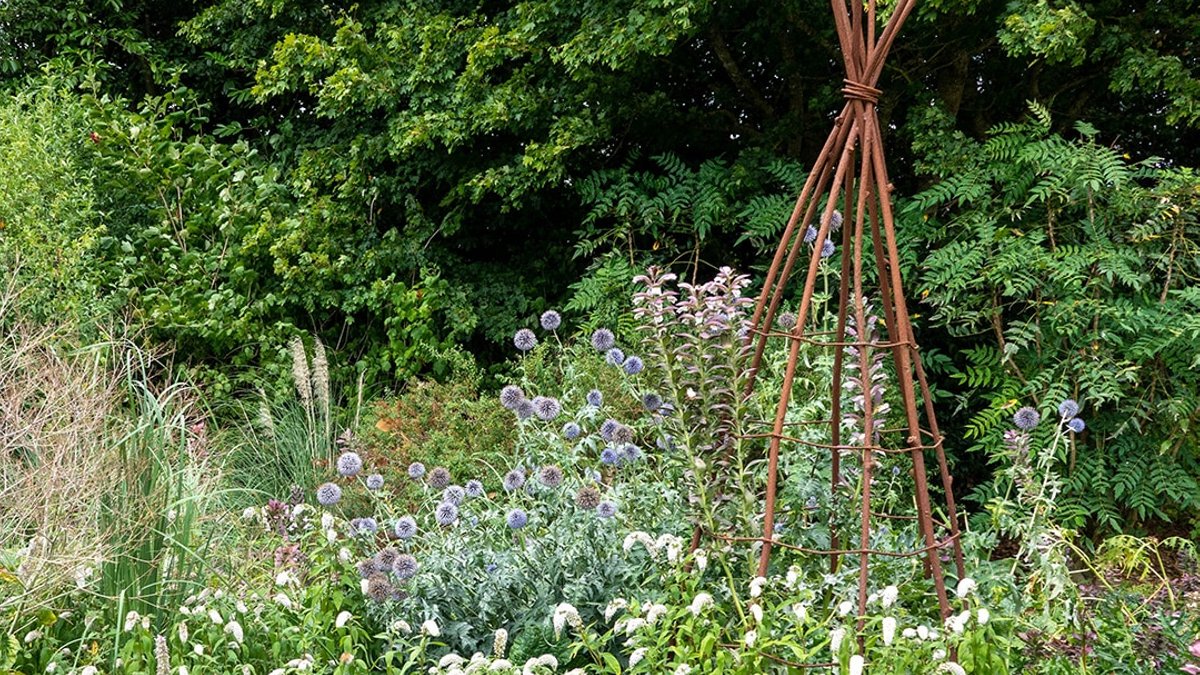
An obelisk in the garden does more than hold up a climber. It breaks the flat line of a border, adds height without bulk, and turns a single plant into a living sculpture. Choosing the right vine ensures it grows tall enough to matter without overwhelming the structure.
Support matters as much as the plant itself. Wooden obelisks—four-sided and often painted to match fences—bring weight and tradition but rot at the base if left in damp soil. Metal versions have gained popularity for their durability. Wire designs appear lightweight, while chunky steel feels permanent. Woven willow or hazel suits cottage gardens, especially when paired with a rust finish. Whatever the material, the obelisk should remain visible through the foliage. A climber that hides every strut can make the arrangement look top-heavy.
Most garden obelisks stand between 2 and 2.5 meters tall. That height excludes vigorous climbers like rambling roses, which can reach 6 meters and quickly overpower the frame. Smaller climbers, repeat-flowering varieties, and compact hybrids work best for these structures.
Related: Best Summer Garden Birds Wildlife Lovers Should Spot
Smaller climbing roses are ideal. Many of the English Roses from David Austin can be grown as shrubs or small climbers. Or try a ‘miniature’ rambler such as pretty ‘Open Arms’ available from Burford Garden Co. with flowers in pale shell-pink, or ‘Warm Welcome’ available from David Austin in hot orange.
Clematis are a natural choice for obelisks, with many flowering for months. Clematis ‘Prince Charles’ available from Gardener’s Dream, for example, will produce its blue-mauve blooms from June to the end of August, while magenta-red ‘Madame Julia Correvon’ available from Crocus will flower freely from July to September. It’s just one of the shorter, more compact clematis you’ll find in the Viticella group. Raymond Evison’s Boulevard clematis, bred to be compact enough to grow in pots, is also ideal for an obelisk, with lovely mauve-purple flowers.
Passionflowers require strong roots and well-draining soil. With an Award of Garden Merit from the RHS, Passiflora caerulea is the best known and widely planted for a reason. An abundance of blue and white flowers appear during the summer, followed by orange fruits that are the size of a hen’s egg. At its maximum, it will reach around 8m tall. A south-facing wall of a house is ideal because it will give a little protection over winter and can make all the difference between your plant surviving and thriving.
For faster growth, Cobaea scandens, a very vigorous climber, grows perfectly against an obelisk placed in a sunny area.
Related: How to Find Your Ideal Bedroom Bedside Cabinets
Most climbers prefer fertile, well-drained soil. Clematis should be planted at least 30cm (12in), and preferably 45-60cm (18-24in) away from the base of a wall or fence to avoid dry root zones. Spring mulching, drought watering, and proper pruning—based on whether the plant flowers on old or new wood—ensure healthy growth.
Gardeners seeking quick results can buy plug plants in spring. Annuals will cover an obelisk in a single season. Perennials take longer but return yearly. In either case, the obelisk should stay visible, reminding the eye that the plant is supported, not the other way around.
Willow obelisks, sold in pairs at 120 centimeters tall, feature spiked feet for easy planting. A taller 150-centimeter version is also available. Both are woven from compostable willow and arrive ready to use. For a more permanent option, a steel obelisk with a solid ball top develops a natural rust finish within weeks, blending into garden settings of any style.


