
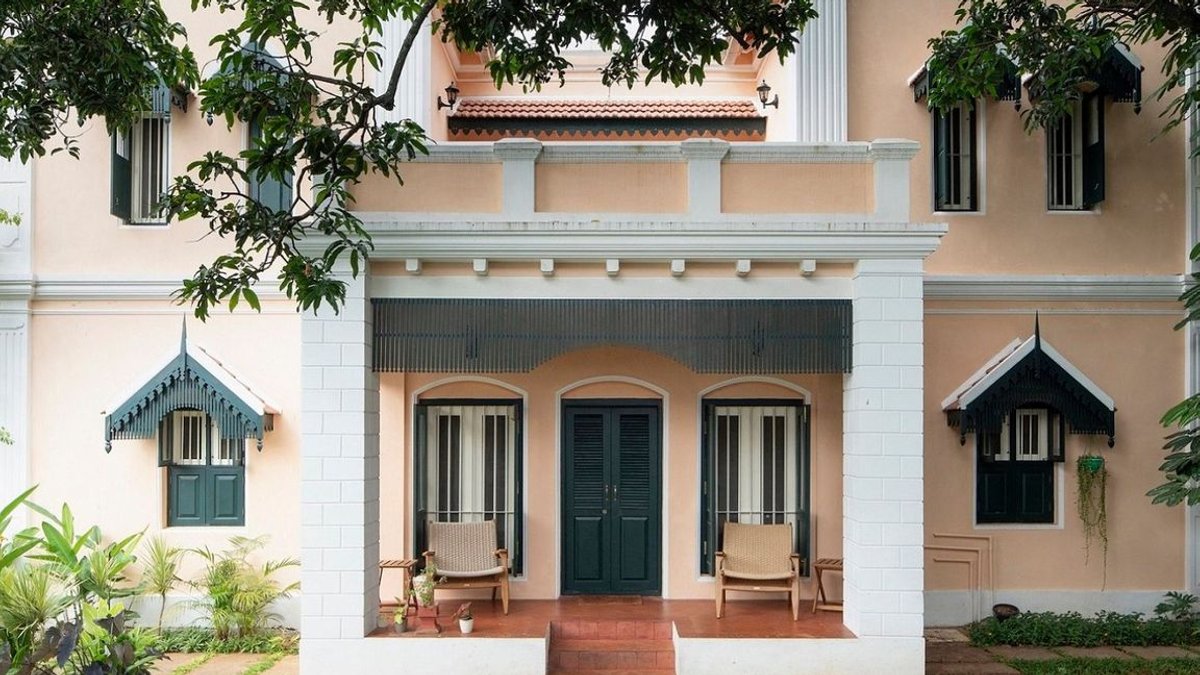
The sleeping quarters of the Mysore villa draw their palette from the local avian life. One room features the gentle amber hue of a yellow-throated bulbul, another showcases the myriad blues reminiscent of an Indian roller, and a third displays the delicate white-and-pink tones of a painted stork. The owners, avid birdwatchers, found plentiful feathered inspiration in Mysore, which hosts one of the area’s most celebrated bird sanctuaries, guiding designer Shruti Jaipuria of MAIA Design Studio.
A Change of Plans
Aditya Guru Dev and Samyukta Lakshmi—descendants of the former Maharaja of Mysore—purchased a bungalow that possessed solid foundations but suffered from a deteriorating roof. Renovation work commenced in 2019 with the intention of converting the property into a four-bedroom boutique guesthouse that would allow visitors to reside within historic Mysore. “When you go to cities like this, you want to experience them for what they are; you don’t necessarily want to stay in a cookie-cutter hotel that could be anywhere in the world,” Jaipuria explains. “We wanted people to experience Mysore in an authentic and rooted way, through the architecture, interiors, and crafts of the region.” Mid-project, the family revised their plan and opted to retain the house as a private weekend retreat. Renamed Raj Vilas, the bungalow now serves as their personal sanctuary.
Design and Decor Details
The bathrooms and kitchen reflect colonial design with modern fixtures styled to appear vintage. Brass fittings and Basel tile floors complete the look. The team sought to ensure comfort remained a priority without sacrificing the traditional aesthetic.
Artworks and objects found in old family books and a doll museum in Koppal also found their way into the home. Each element was chosen to tell a story relevant beyond its appearance.
Structural Integrity
To address the building’s restoration, the owners enlisted conservation architect Sanjog Shetty, a longtime associate of Guru Dev. “Aditya had told me that whenever he would decide to renovate his property in Mysore, he would like me to be a part of the collaboration,” Shetty says. By the time he got the call, the building was structurally sound but showing its age everywhere else: rotted rafters under the tiled roof, tired window frames, lime cornices crumbling at the edges. Shetty stripped the building of later finishes and re-plastered it in lime mortar.
His team dismantled the roof systems where they had to, replacing the timber that was too far gone, treating and reusing what was salvageable, and rebuilding the pitched roof with the same Mangalore tiles it had always had. Early-20th-century Basel Mission terra-cotta tiles were retained in select areas throughout the house. “Every aspect was important to maintain the character of the building,” Shetty says. “Without the authenticity of the construction technique, the restoration would have lacked the soul of what we were preserving.”
Historical Artifacts
Jaipuria’s interior concept adhered to a clear principle: preserve original components wherever feasible, reproduce them where necessary, and avoid introducing overtly modern elements. “The client was very clear that we had to use as many original elements as possible,” she states. “Even new interventions were replicated to resemble the originals, such as the doors and windows, and the POP moldings replicated the originals in all of the rooms.” The 120-year-old staircase was retained, with newly fabricated railings fashioned to match the historic design. Antique furnishings were sourced from dealers in Bangalore, Mumbai and Kerala; pieces from Saanchi, Gulmohar Lane, Mahendra Doshi and Accurate Antiques now occupy spaces beneath a skylit stairwell or anchor a sitting area, each bearing its own provenance.
The decorative objects throughout the residence also carry distinct histories. While reviewing family archives, Jaipuria discovered the Sri Tattva Nidhi, a collection of artworks, musical scores and literary excerpts compiled by Krishna Raja Wodeyar III, a former Mysore maharaja. Reproduced prints from this compilation now adorn the walls.
A visit to a doll museum in Koppal yielded a selection of Kinnala dolls, which were purchased to embellish Raj Vilas. “These are wooden dolls made in the Koppal district of Karnataka, which is a 500-year-old craft cluster,” Jaipuria explains. “We wanted each element in the project to tell a story and be relevant beyond aesthetics.” The bathrooms and kitchen draw on colonial motifs, featuring contemporary fixtures designed to appear vintage, set against Basel tile flooring and brass hardware that could plausibly date back to the early 1900s. For both Jaipuria and her clients, maintaining comfort while honoring traditional design was vital.


